

Tired of high electricity bills? Grid instability is a major headache for homeowners. Because of this, many people across Rawalpindi are shifting toward clean solar energy.
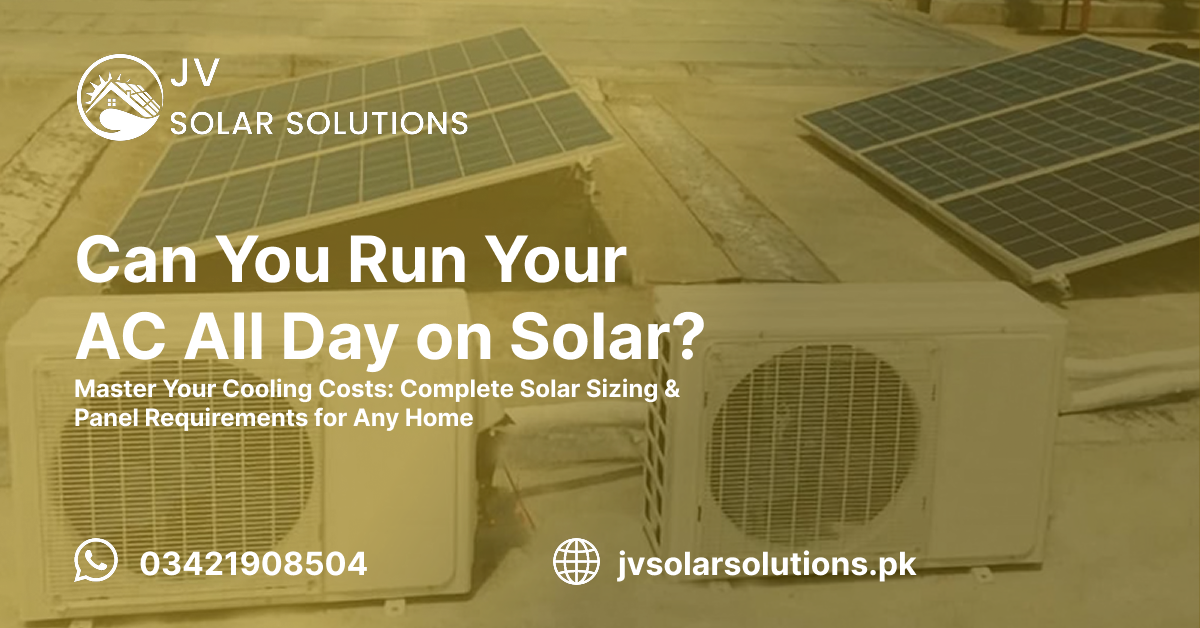
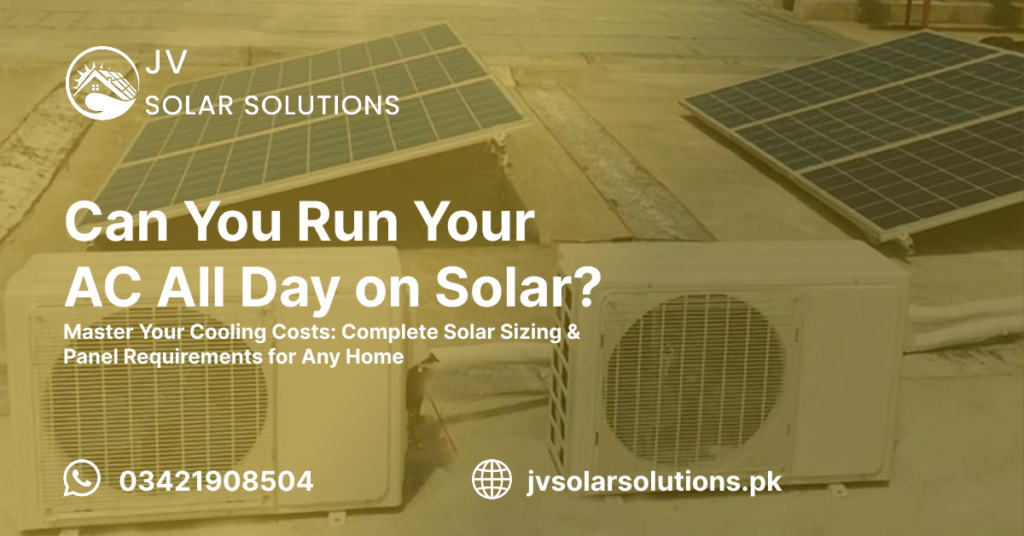
One of the most common questions property owners ask is: Can you actually run your air conditioner all day on a solar system?
The short answer is yes, absolutely.
Modern photovoltaic technology, efficient inverter compressors, and lithium storage batteries make all-day cooling entirely possible. However, achieving smooth, uninterrupted cooling requires proper capacity planning, the right inverter size, and an adequate number of solar panels. This comprehensive guide breaks down real-world usage scenarios, exact panel requirements for different AC tonnages, and how to get professional installation services.
Understanding How Solar Powers Air Conditioning
To understand how solar handles cooling, you first need to look at how your home consumes electricity during the day versus at night.
Solar panels generate electricity only when the sun is shining. During peak daylight hours, your solar array produces maximum power. This free solar energy first powers your active household appliances—including your air conditioner. If your panels produce more electricity than your home is using at that exact moment, the excess power is either sent back to the utility grid through net metering or stored in batteries.
However, air conditioners are heavy electrical loads. A standard non-inverter AC draws a massive surge of current every time the compressor kicks on, which can easily trip a weak solar inverter. This is why modern solar setups require careful matching between your AC units and your overall system capacity.
Scenario Breakdown: Powering ACs on Solar
Let’s look at common real-world installation scenarios to see how solar handles different cooling needs.
1. Running a 1.5-Ton Inverter AC on a 5kW System
A 5kW setup is one of the most popular configurations for medium-sized homes in Rawalpindi.
- Daytime Operation: A 5kW system generates plenty of power during peak sun hours. It comfortably runs a 1.5-ton inverter AC (which typically uses about 1,200W to 1,500W once the room is cooled) right alongside your refrigerator, LED lights, ceiling fans, and television.
- Nighttime Operation: Standard on-grid solar systems automatically switch back to the utility grid after sunset because panels stop producing power. If you want to run your 1.5-ton AC on solar power through the night, your system must be configured as a hybrid setup paired with a reliable lithium battery bank (such as a 5kWh to 10kWh storage pack).
2. Running Multiple ACs in Larger Homes
If your property requires simultaneous cooling across multiple rooms or floors, a compact 5kW system will not be enough.
- Two 1.5-Ton ACs: You will need at least an 8kW to 10kW solar system to cover simultaneous daytime cooling and normal household base consumption without overloading your inverter.
- Three or More ACs (Mixed Tonnages): Large double-unit houses running a mix of 1-ton, 1.5-ton, and 2-ton units require a robust 12kW to 15kW+ three-phase system to maintain balanced voltage phases and handle heavy domestic loads safely.
How Many Solar Panels Do You Need for an AC?
Solar panels power your entire house as a unified generation pool. However, if you want to calculate how many extra panels your cooling load specifically requires, use this simple estimate based on high-efficiency Tier-1 panels:
- 1-Ton Inverter AC: Requires about 3 to 4 solar panels (roughly a 2kW system capacity addition).
- 1.5-Ton Inverter AC: Requires about 4 to 5 solar panels (roughly a 2.5kW to 3kW system capacity addition).
- 2-Ton Inverter AC: Requires about 6 to 7 solar panels (roughly a 3.5kW to 4kW system capacity addition).
Pro Tip: Always choose modern inverter ACs instead of legacy non-inverter models. Inverter compressors adjust their operating speeds dynamically rather than turning completely on and off. This reduces electricity consumption by 30% to 40%, making them vastly superior for solar panel and battery integration.
Quick System Capacity Reference Table
| System Size | Best Suited For | Typical Home Load | Recommended Setup Type |
| 3 kW | Small portion / 3 rooms | Lights, fans, fridge, 1 small AC | Hybrid or On-Grid |
| 5 kW – 6 kW | 5 to 10 Marla home | 2 Inverter ACs + full home load | Hybrid with Lithium Battery |
| 8 kW – 10 kW | Large double-unit home | 3 to 4 ACs + heavy appliances | Three-Phase Hybrid or On-Grid |
| 15 kW+ | Large villa or plaza | Heavy commercial load / Multi-AC units | Industrial Three-Phase Setup |
Expert Installation & Professional Services
Designing a solar array that effortlessly manages heavy air conditioning loads requires meticulous load calculations, safe wiring practices, and top-tier hardware. Poor installation or undersized wiring can lead to system tripping, equipment damage, and inefficient cooling.
If you want honest capacity advice, high-grade equipment, and clean execution, JV Solar Solutions, located on College Road, Rawalpindi, provides leading solar systems and professional installation services across all neighborhoods of Rawalpindi. Whether you need a reliable hybrid lithium setup for uninterrupted night cooling or an optimized net-metering layout to drop your electricity bills to zero, their technical team ensures safe, high-performing energy solutions customized for your property.